Stepping inside Claire Perini's Avalon home is like being transported to a bygone era of Italian Art Deco. The founder of Cosmopolitan in Surry Hills has recently renovated the space, which captures her design philosophy — one that is rooted in storytelling, with a touch of timeless minimalism.
The coastal home evokes a quiet nostalgia, shaped by mid-century lighting, well-travelled objects rich with patina, and bespoke joinery that reflects Perini’s sentimental eye. Every detail is considered, and each design addition is intentional, creating a lived-in feeling that mirrors the expressive evolution of Cosmopolitan itself. History lives in perfect harmony with the contemporary interior of Perini’s home, providing the perfect landscape for new stories to unfold within its four walls..
Next April, Perini will exercise her interior and antique prowess on an intimate sourcing tour through Paris, Avignon, Marseille, and Montpellier. Across the twelve-day expedition, she will will offer access to her long-standing network of antique dealers, restorers and local artisans — alongside a glimpse into her rulebook on collecting.
Ahead, read Claire's motivations behind the renovation, her affinity for imperfect objects, and what the perfect soundtrack to her home would be.
The home feels deeply personal, almost autobiographical. When you walk through it now, what part of your own story do you see reflected back at you?
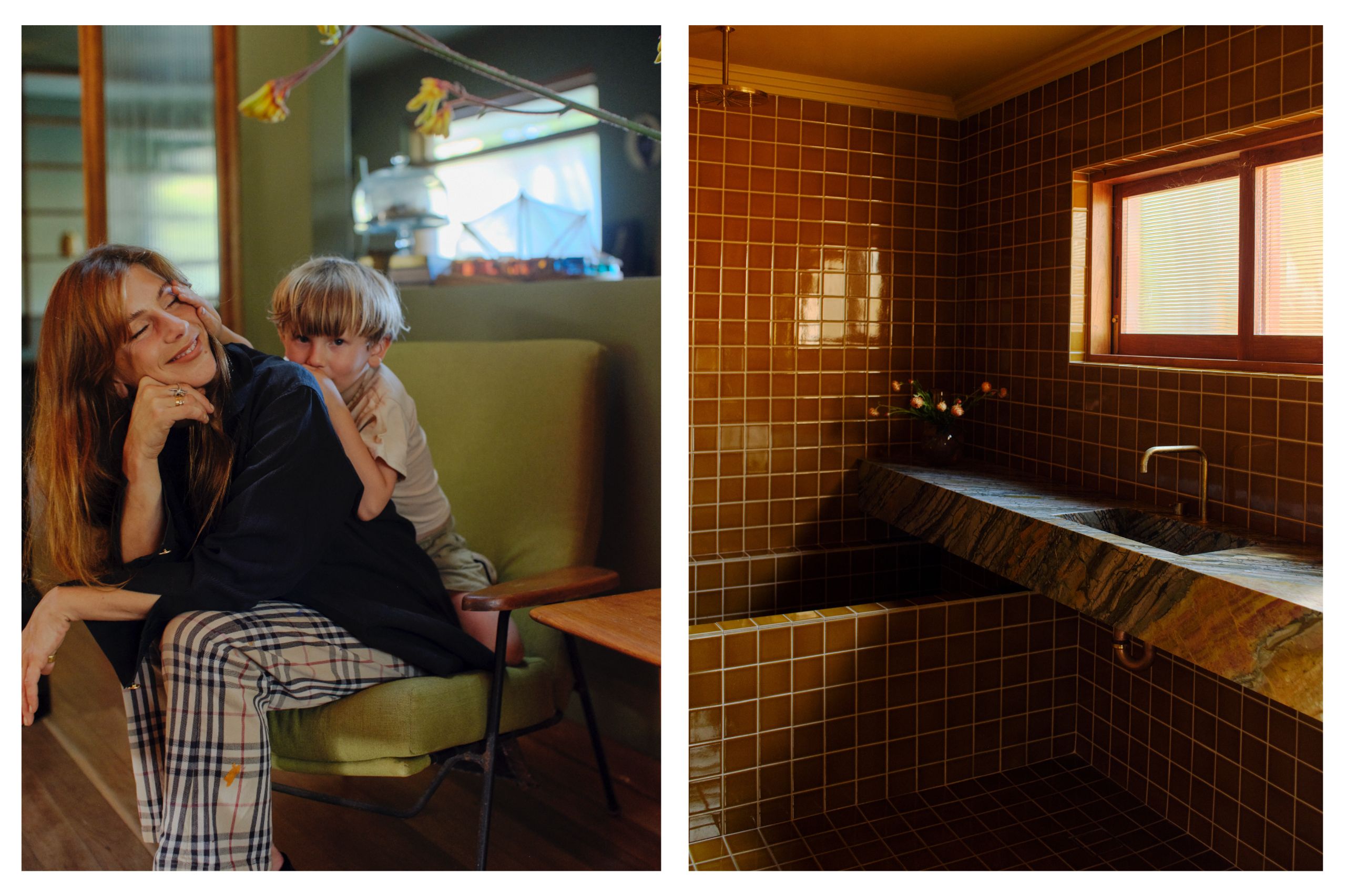
Deeply personal is a very apt way to describe my home. This space has been a huge part of my healing journey after a challenging few years. It stands now as a symbol of strength and renewal — a place where I rebuilt both physically and emotionally. There’s a deep sense of pride when I walk through it, not just in the materials or design choices, but in the growth that happened here.
In many ways, the house mirrors the journey of Composition itself — layered, evolving, and quietly expressive. It reflects the same aesthetic that guides my work: considered, soulful, and rooted in storytelling. Every texture, colour and piece has a purpose — not to impress, but to feel lived-in, loved and true.
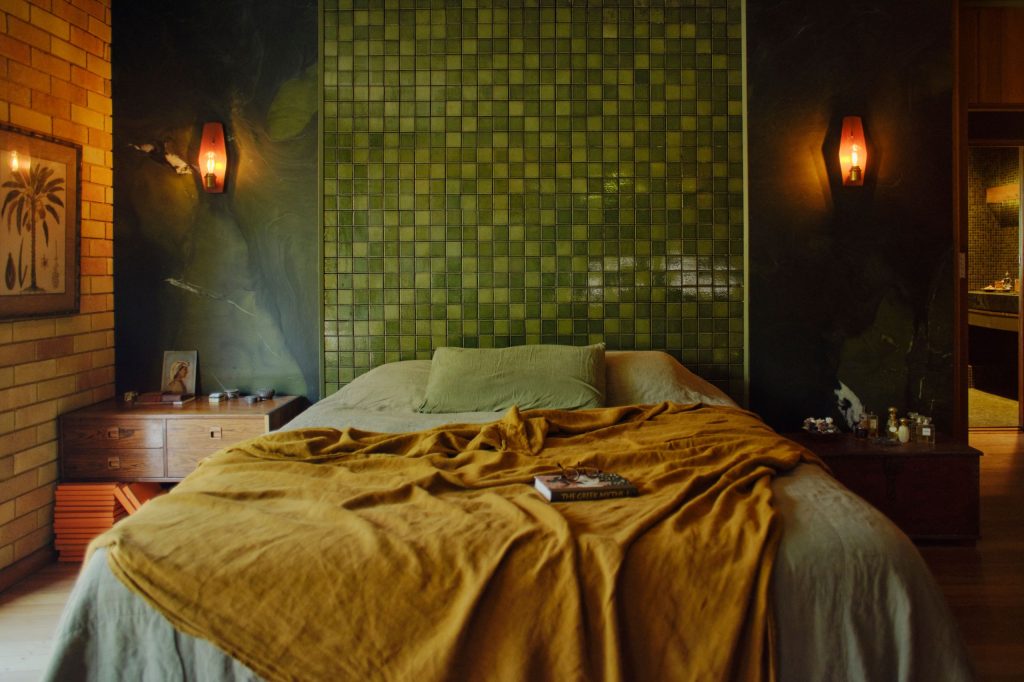
There’s an enveloping warmth to the palette – green walls, timber, sunlight. How do you think about colour as an emotional language rather than a decorative choice?
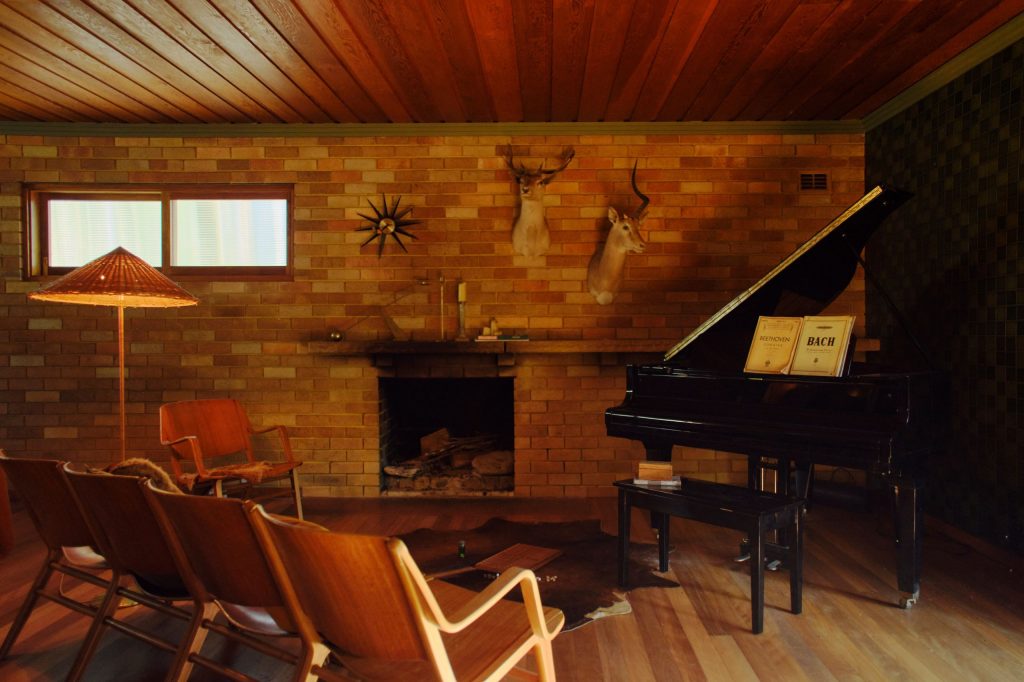
The palette almost revealed itself before I had any real say in it. When I bought the house from its original owner, ‘Granny Annie’, who was in her 90s, its late-1950s bones were already glowing with warmth. She and her husband had built it together, and though the layout was simple, the use of natural materials gave it a quiet richness, a sense of soul you can’t replicate.
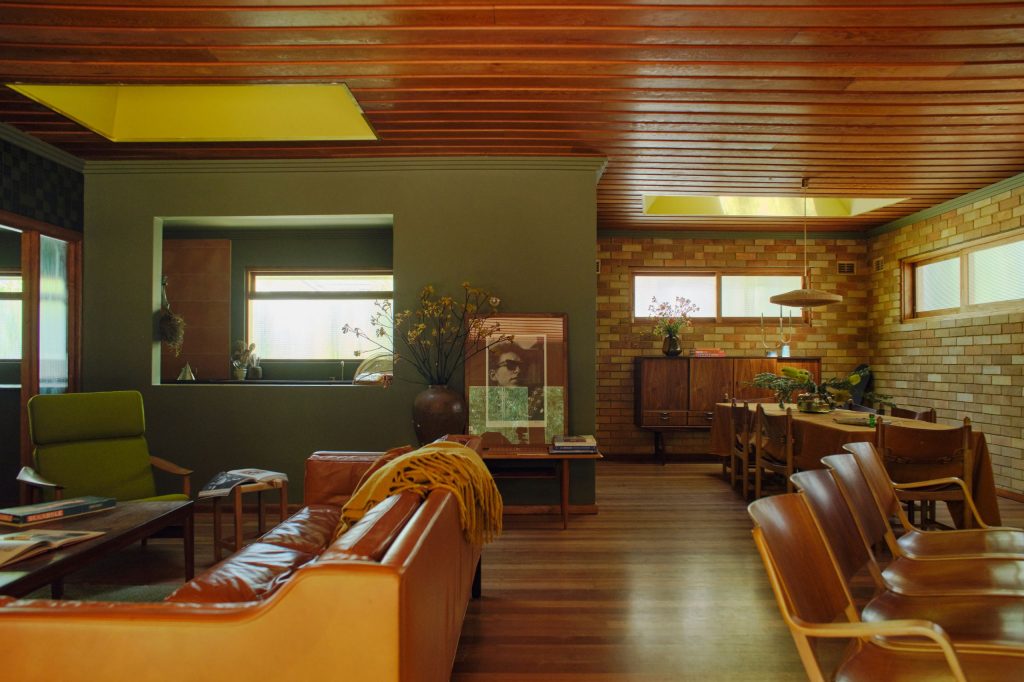
The original Oregon shiplap ceilings in the living room are still my favourite element, and much of the design grew from there. The decision to bring green in as the base tone came from both a personal love of the colour and the environment that cradles the house, especially the towering angophoras that wrap around the block. For me, colour isn’t decoration; it’s a feeling. Here, it connects the home to its landscape, bringing calm, depth and a sense of belonging.
Your work often feels like a conversation between past and present. How do you decide which parts of history to invite into a contemporary space?
For me, it’s rarely a conscious decision about which parts of history to include — it’s more about an emotional pull toward a particular object. Often there’s a small corner or vignette in the home that’s been sitting quietly in the back of my mind, waiting for the right piece to find it. Then, while travelling or sourcing, I’ll come across something that feels like it was always meant for that spot — a little moment of recognition.
I’ve always believed that the objects in a home should tell your story; they’re an exhibition of your life. History, to me, should live naturally within an interior — each piece carrying a trace of where it came from, what it evokes, and how it connects to your own memories. I love a contemporary space because it provides that calm, gallery-like backdrop — a pared-back canvas that allows those storied objects to truly shine.
Every designer has one object that anchors the whole room. What piece holds the emotional centre of this home for you?
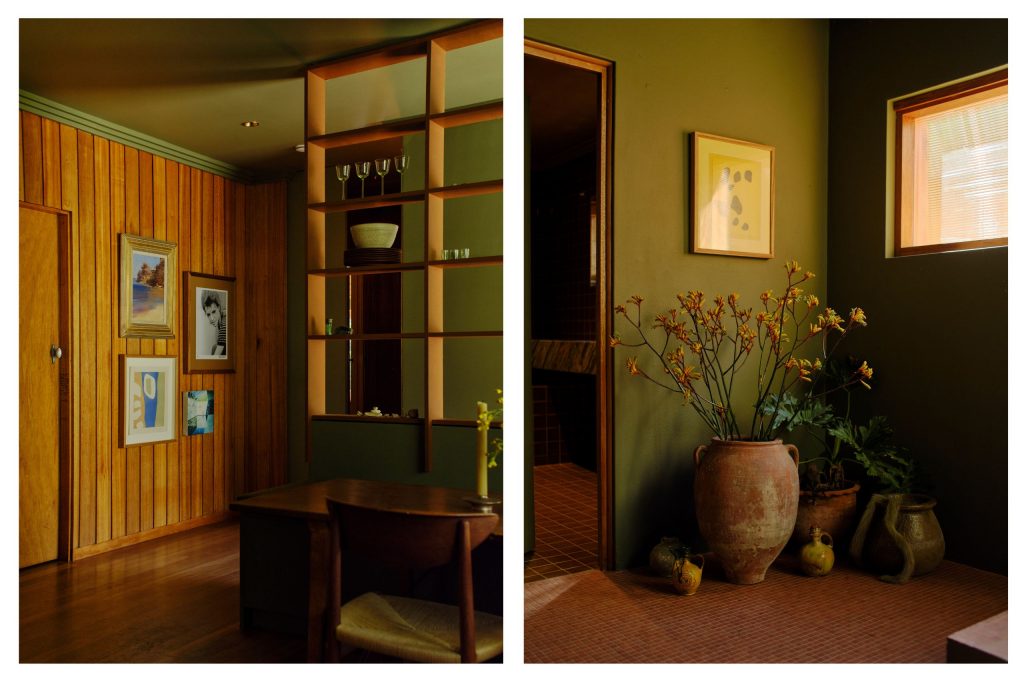
I’ve been racking my brain trying to think of one object that truly anchors the room, but I don’t think there is just one. For me, it’s more about a series of small pieces in each space little focal points that draw the eye and create rhythm throughout the home. I like setting up vignettes, almost like a showroom, rather than a typical interior. A few of my special pieces include an autographed photograph of Bob Dylan, an original Hans Arp lithograph, a set of green champagne coupes, a 1940s Japanese ceramic vase burnt in a fire, a rare 1960s Scandinavian backgammon board, and my collection of first-edition architecture books. It’s these smaller moments that guide how I place and layer everything else — making one the hero and letting the surrounding details lead your eye toward it.
What role does imperfection play in your process – the worn edge of timber, the uneven glaze of a ceramic – those human traces that make a room feel lived in?
Imperfection is everything to me. There’s a famous, perhaps overused, quote by Leonard Cohen that’s always resonated: “There’s a crack in everything — that’s how the light gets in.” Most of my life choices have been guided by that sentiment. To me, imperfection reveals the human element — the touch of the maker, the trace of a former owner, even something as small as a century-old price sticker left on the back of a piece. Those little details are often the very reason I’m drawn to an object in the first place.
Imperfection, though, is about balance. Every piece can carry its own marks of time, but too many with the same material or level of wear can make a space feel unresolved, even careless. I believe in celebrating the character within each object, and when something truly is beyond repair, I try to find another use for it. That process often leads to unexpected design ideas or new ways of seeing the object altogether.
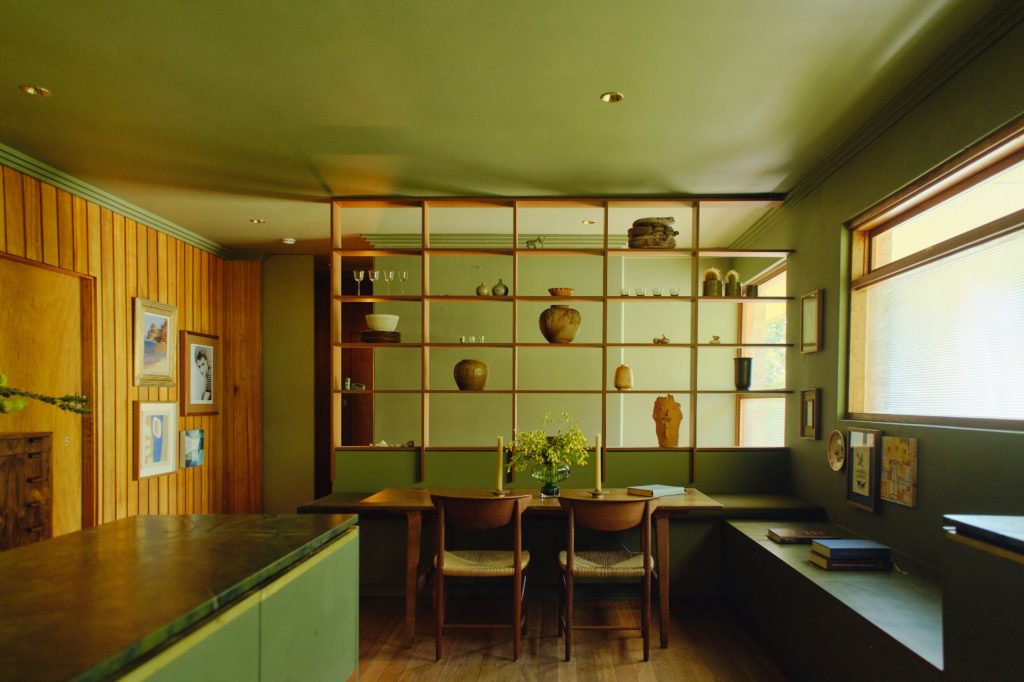
The dining area feels almost like a still life – a composition of texture, tone, and light. How do you balance the instinctive with the intentional when styling a space?
The dining space I think you’re referencing is the more informal one, and it’s one of my favourite areas in the house. When I first bought the home, what’s now a set of open shelves was once a solid wall that blocked the natural light and obscured the beautiful original double-height fluted glass front door. I wanted to celebrate that rediscovered light, and the result was an open display of my most loved ceramics and rock collections.
The intentional part was creating that moment; the instinctive came later, in the years spent watching the light dance through the room, across those small details, and in the slow, evolving process of collecting the objects that now live there. I do tend to rearrange things from time to time, but only when something feels out of place. Some pieces seem to find their perfect spot, and stay there for years.
You often source from Europe and Morocco. Is there a moment from one of those trips – a market stall, a found object – that changed how you see materials or design?
Definitely. I used to associate tapestry and weaving, especially those with more traditional, motif-based designs with the bad décor of the ’80s and ’90s homes I grew up around. I never had a particular love for them, apart from the modernist works of designers like Eileen Gray. But during my travels through Morocco, learning about the deep history of villages and their storytelling through different weaving styles completely changed my perspective.
After spending more time travelling across Europe, my appreciation for a range of styles and eras has only deepened. I now often find myself heading straight to the brocantes and markets in search of them. A complete convert, I’ve gone from walking over them to hanging them — admiring them as art rather than simply using them underfoot.
Renovating your family home must have brought a different kind of pressure – how did you create a space that feels both deeply designed and genuinely livable?
The bones of this house really encourage a liveable sensibility, through its hard-wearing material base and even in its original name, ‘Basecamp’, which still adorns the entrance door. When approaching the design intervention to the home, the decision to keep this was less a choice and more mandatory — I’m a slight bull in a china shop, and so is my five-year-old son. As a small family, we are deeply creative, so for me, furniture needs not to be precious. Especially table tops and surface choices (and most others) were made with the knowledge that they would patina over time.
Ultimately, I love a home to feel lived in — that’s the ultimate goal for me: lived in, yet not a barnyard. As the client, my approach was to celebrate my different collections of objects, art, books, music paraphernalia, and many, many rocks. The intent was for the house to be a display — with objects raised off the floor and furniture displayed sparingly to accommodate this, creating little still lifes in abundance.

There’s a cinematic quality to the light in this house – filtered, soft, deliberate. How does light guide your decisions when shaping a space?
Given my background in interior and spatial design, this is always at the forefront of my design decisions. I am also very sensitive to light — it seriously affects my mood (as I believe it does everyone). I grew up in a home with a quirky mother; she didn’t feel the need for ceiling lights in the house, and I think (without realising it until now) I’ve carried this quirk on.
For one, I believe that low lighting makes a space feel warmer and cosier, but it also seems to make the ceilings feel as though they’re somewhere above, giving a sense of height in a sort of backwards way. When I do use ceiling lights (because I’m not completely nuts), I try to use them sparingly and with the direct purpose of framing a moment. Otherwise, I’m a big fan of using vintage lighting — so anywhere I can add them, I do. Vintage lighting is a really easy way to introduce added warmth to your lighting scheme or interior. My favourite piece in my home is the Temde Leuchten pendant above the formal dining area; I love the materials and the way they create dynamic shadows.
If your home had a soundtrack – the sounds of morning light or late-night quiet – what would we hear?
Well, always and forever, my love for The Rolling Stones blares high. I truly believe there’s a Stones song for any place and any time. When I’m sitting late at night with friends in my living room — timber ceiling above, low light, fire blazing, wine pouring — my song of choice would be “Heaven” from the studio album Tattoo You (1981). I like to think of it as the perfect song to walk into a smoky room to — it just accompanies you.


Feature image: courtesy of Augusta and Foster