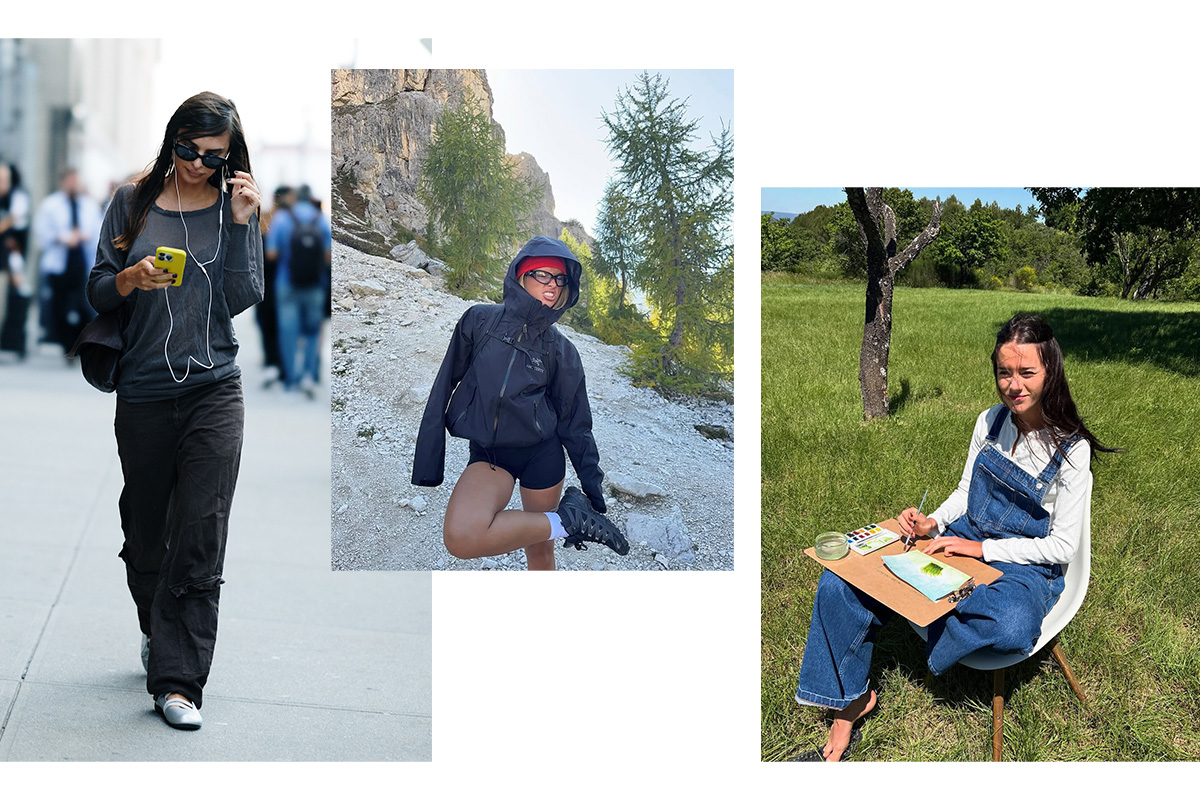
Yes, it's 2025, and “having a life” has become an aesthetic category. 'Having-a-life-core' was coined by TikToker Jayne (@didoriot) this week, and captures a recent subtle but seismic shift in fashion. Specifically, we’ve gone from celebrating the aloof, off-duty party girl of the early 2000s, to idolising the person who looks like they’ve just come from a pottery class, or are en route to a hike. In other words, it’s no longer enough to just be — you have to be seen doing.
In order to understand how we got here, we need to first look to the past. In the late noughties and early 2000s, coolness was still tied to effortlessness. The It-girls of the era — think early paparazzi shots of young Kate Moss, and later Paris Hilton — were enviable precisely because they appeared to do nothing. Their job was to exist. The look was slept-in eyeliner, indie sleaze hair, and a sense of casual disinterest. As a result of their pre-eminence, aloofness became equated with the height of fashion.
But, as Jayne points out, fast forward to 2020 and COVID meant we actually were all forced to sit around doing nothing. Two years of endless hours in tracksuit pants, Zoom calls, and homemade banana bread made doing nothing feel less like a flex and more like a symptom. Naturally, Jayne explains, "the goalposts have to move." So where, exactly, did they move to? Towards doing. Effort became aspirational. Suddenly, it's no longer cool to sit around anymore; it's cool to be seen living.
You can trace this recalibration through the rise of gorpcore, which sees luxury hiking gear and technical outerwear became wardrobe mainstays, implying that you might, at any moment, go on a hike (even if you’re just getting coffee). But having-a-life-core goes a step further. It’s not just about performance dressing for activities; it’s about embodying a lifestyle so rich with plans, projects, and pursuits that your outfit feels like an afterthought.
To exemplify her point, Jayne shows us two images. The first is of Mia Goth, arriving on the set of MaXXXine in an oversized plaid shirt, baggy trousers, Birkenstocks, sunglasses, and a claw clip. The second is similar: Natalia Dyer walks her dog in an oversized Brandy Melville hoodie, baggy jeans, red headphones, and a cross-body bag. To the untrained eye, both outfits are unremarkable. But to those fluent in having-a-life-core, they're the picture of busy-chic.
The trend also reflects a broader economic truth: that living — dining out, travelling, taking classes, even leisure — has become a form of privilege. As the cost of living rises, economic capital — buying a home, investing in shares — becomes increasingly out of reach. In its place, cultural capital — experiences like hiking, reading, or attending live music — emerges as a key marker of wealth. As one TikTok commenter put it, we're aspire to look like this “because living your life [has become] a luxury.” The clothes follow the sentiment. We dress to look like we can afford to do things — to fill our days, our feeds, our wardrobes — with life.
The irony, of course, is abundant. We’re dressing up as people who have better things to do than think about what they’re wearing. In reality, of course, it’s all a self-referential loop. Scouring Pinterest for outfits that exude nonchalance is, at its core, quite chalant.