There are few objects in fashion that transcend their own utility. The Lady Dior is one of them. More than a handbag, it is an icon: sculptural, storied, and endlessly reimagined. Since its debut in 1995, it has embodied the spirit of Dior – discipline meeting poetry, structure yielding to softness. In 2025, the House celebrates ten years of the Dior Lady Art project, an initiative that invites artists from around the world to transform the bag into a living work of art.
This anniversary edition feels particularly poignant, not only for its milestone, but for the plurality of voices it gathers. Ten artists – stretching from Paris to Seoul, Lagos to Beijing – unite under a single object, each layering their own truth onto its timeless silhouette. Among them is Ju Ting, the Beijing-based artist whose practice dissolves the boundary between painting and sculpture. Known for her layered surfaces – sliced, carved, and revealed like geological strata – she brings to Dior a language of depth, tactility, and motion.
“Through Dior’s history, I saw how a fashion brand can preserve its heritage while continuing to push boundaries,” she says. “Just as my artistic style is constantly evolving, I admire that the Lady Dior handbag is art in motion.”
For Lady Dior Art #10, Ju Ting turned to her Amber series, a body of work born from reflections on the uncertainties of life. “The Amber series was inspired by the way amber forms – encased chance and sealed by time – where accident and inevitability quietly converge,” she explains. “Even after the long, forgetful drift of time, it still casts a light that stirs the soul”.
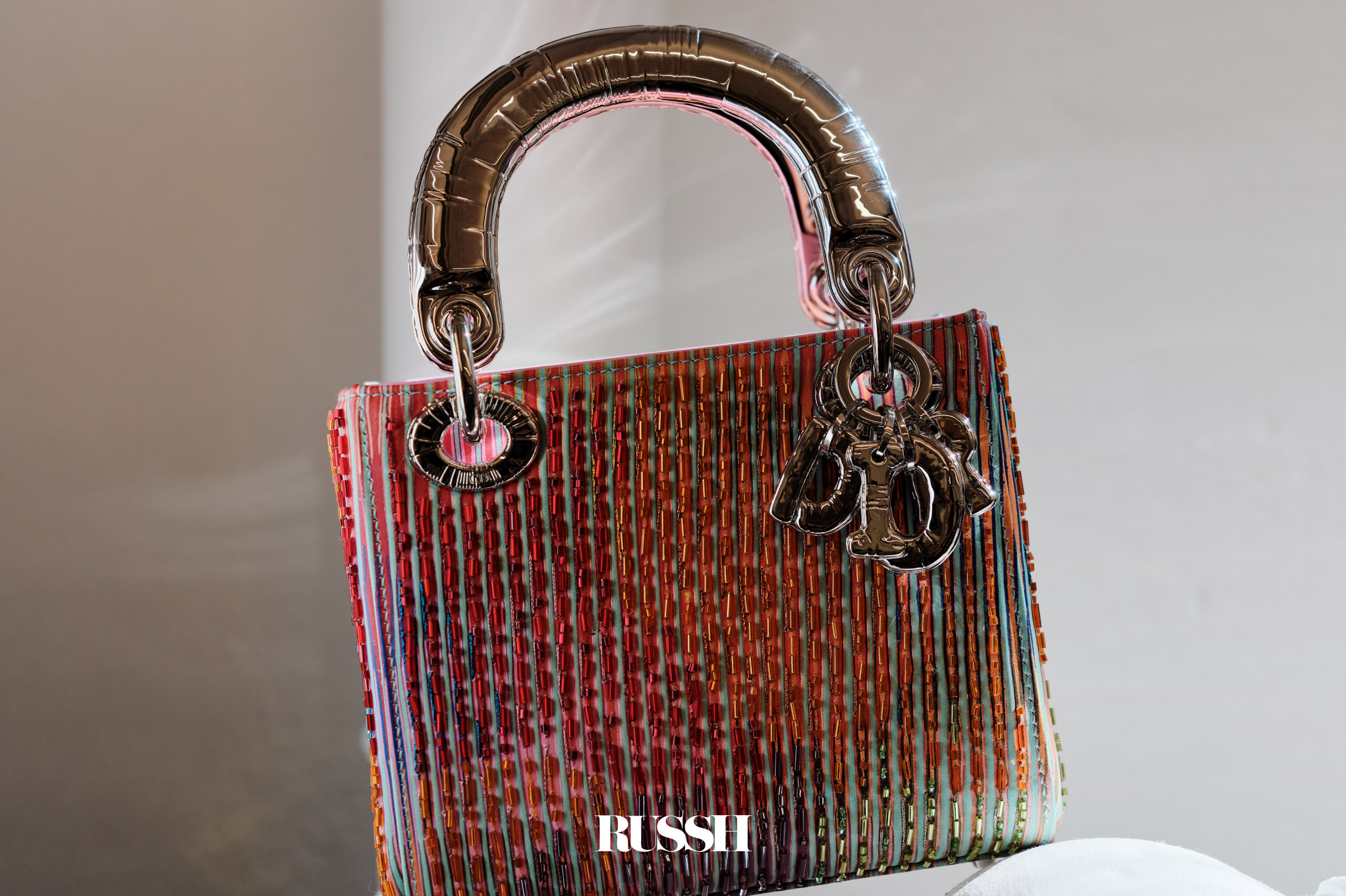
Her reinterpretation of the Lady Dior captures that paradox of permanence and fragility, clarity and opacity, unity and dissonance. The medium handbag is defined by sweeping linear patterns layered with 3D-printed relief, echoing the crystallised tones of amber. The mini version, by contrast, shimmers with countless irregular glass tubes, each hand-stitched to refract light into prisms that dance across its surface. Both pieces, she notes, were conceived with “a deliberate dissonance – the clash of polished industrial hardware against the softness of leather – something I often explore in my practice”.
“They spoke French, I spoke Chinese, and yet they fully grasped what I meant. It reminded me that the language of art knows no borders”.
If the Lady Dior is a vessel of history, it is also a canvas for connection. Ju Ting recalls her first conversations with Dior’s artisans as a revelation. “Despite never having seen my work in person, they came prepared with over thirty material proposals. Their preparation was nothing short of stunning – so precise, so considered,” she says. “They spoke French, I spoke Chinese, and yet they fully grasped what I meant. It reminded me that the language of art knows no borders”.
That sense of togetherness mirrors the very premise of Dior Lady Art. Ten artists, ten perspectives, one object of desire. Each bag is singular, yet together they form a constellation – different, dazzling interpretations bound by the enduring codes of the House. For Ju Ting, this resonance is deeply personal.
“My creative work has always been shaped by personal growth, intertwined with shifts in society and the changing roles of women,” she reflects. “This collaboration brings those reflections back to a form originally created for women – the Lady Dior handbag – bringing everything a meaningful full circle”.
Looking at her designs, one can feel the quiet kinetic energy she so often channels in her work. Layers swell and recede, surfaces refract and glimmer, movement is caught mid-breath. In her hands, the Lady Dior is both static and alive: a crystallisation of past and present, yet always in motion. Like amber itself, it captures unity through fragments, gathering time, memory, and light into something eternal.