Could there be any better ways to spend your Friday night than speaking to a visionary artist? For me, probably not. The power of the full moon seemed to curse our tech, but once connected encouraged a conversation fueled by feminine creativity, intuition, and the creation combined with loss when making records.
My friends and I fell in love with 070 Shake during her live performance at Splendour in the Grass back in 2023 (remember that old thing?), so when speaking across the void it always feels a little more special, intimate and real when the artist has their camera on. I’m always looking to see what parts of their conversational selves are hidden within their performative onstage DNA, and with Shake, she’s just as cool; eating a croissant in Paris.
When doing my research, I know she likes red wine to ‘keep it classy’, so as I have a sip of mine, I reassure her this is not an alarming breakfast-time habit; it’s evening here. Perhaps with relief she tells me she’s a red wine girl too, “always.”
"There's something about putting something out that makes me feel a little bit detached from it. It starts to feel a little bit impure, it feels tainted a little bit."
I feel it’s always the sign of a good record when it’s hard to explain what genre it is or immediately pin point references, Petrichor – the New Jersey musician's third studio album – is definitely one of those records. It having been out for a while, I’m curious to know how it sits with her, but she seems to step away from the concept of reception altogether.
“I don’t pay attention enough to the aftermath of dropping something," Shake tells me. "There's something about putting something out that makes me feel a little bit detached from it. It starts to feel a little bit impure, it feels tainted a little bit.”
Many artists I have spoken with seem to have this shift – where the personal and almost hermetic joy of their art mutates into something that other people can tear apart. “I always like songs, to me, way better before I put them out," she continues. "They completely change once I know they’re out. I could really, really love a song, and then once I put it out, I’m just like… not really that in love with it anymore.”
For an artist who is actively documenting love, I push a little deeper, and she explains her process a little further. “When I’m in the process of making something, it’s just pure and it is what it is. It doesn’t have to be criticised. I just… I keep it safe, you know? I keep it safe. But that’s just part of the process.” Before people can objectify the work or criticise it, “it is what it is.”
Shake has spoken before about journalling and poetry as integral to her process, naturally I ask to know more about the writers that influence her own lyricism and poetry, Audre Lorde? Sylvia Plath?
“There are people that are way more seasoned than I am [in poetry]. But I kind of lock into certain things.”
“I really love Sylvia Plath,” she says. We talk about Mirror, Plath’s poem about female self-perception and ageing, and then about Anne Sexton, whose work Shake frequently returns to: “Anne Sexton is incredible,” she says with emphasis. She brings up the poem Sexton wrote to Plath after her death, dedicated to her friend and rival.
“They spoke about suicide a lot to each other,” Shake says quietly. “In a way, they kind of kept each other alive. And then Sylvia went on to, you know, do that, unfortunately.” She paraphrases Sexton’s lines about death arriving like a prize one friend took without the other. “It almost felt like a competitive thing,” she says. “Like, the fact that 'you did it without me'.”
She speaks with the passion of a scholar yet protests not to be well-versed in poetry. “There are people that are way more seasoned than I am. But I kind of lock into certain things.”
If poetry shapes the language of her music, cinema shapes its visual architecture. Although Shake says she would never call herself a cinephile in the rigorous, archivist sense, she would have films like Bergman’s Persona playing on mute during her recording sessions.
“I don’t mean to be such a regular – because Paul Thomas Anderson is one of many peoples' favourite directors, and I think there’s a good reason for that. He’s made a lot of my favourite movies. I would dream to, you know? I mean, that’s another level.”
“I do love movies,” she admits. “I’m very, very passionate about it; very intrigued by it. It’s a big part of my music-making process.” And if she was asked to do a film soundtrack for anyone? “I don’t mean to be such a regular,” she laughs, “because Paul Thomas Anderson is one of many peoples' favourite directors – and I think there’s a good reason for that. He’s made a lot of my favourite movies. I would dream to, you know? I mean, that’s another level.”
However, whilst PTA might be the dream, on scoring she’s pretty open: “Anybody that allows me to, honestly,” she says. “I’m not precious about it.”
Cinema obviously plays a huge role in her visuals, each video or image creating a unique world rather than a consistent universe. “Visuals for music are very important,” she tells me. “It further gives life to a specific kind of communication, which is music. It adds to the mould of it, into the body of it. It’s arms and legs, you know?”
"[Music's visuals] add to the mould of it, into the body of it. It’s arms and legs, you know?"
“When you get the opportunity to make a visual that properly helps mould that vision, it feels very satisfying. You feel like you have a full thought, a full vision. It’s complete.”
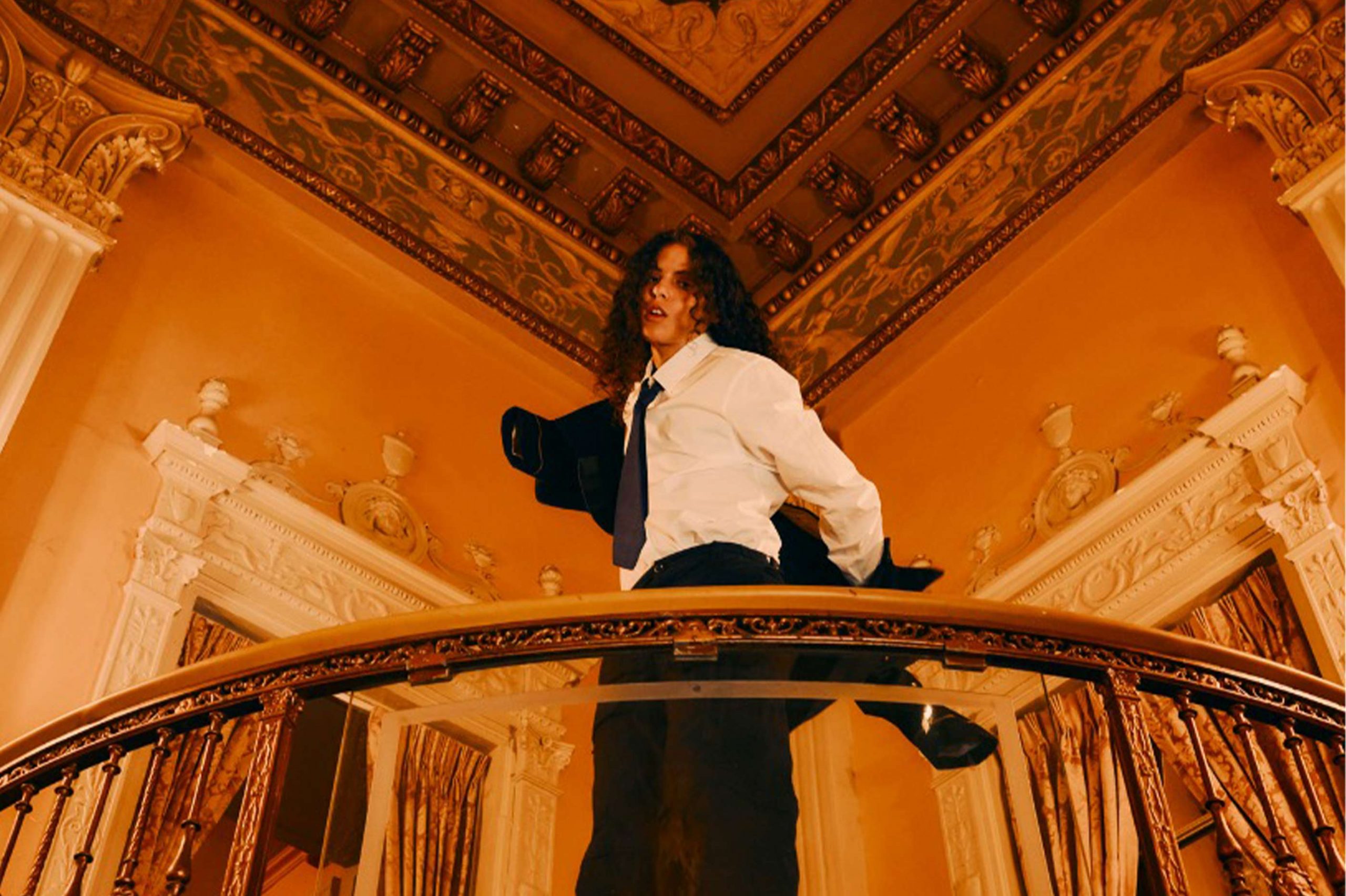
When you think of 070 Shake, you can’t help but draw to mind an androgynous love of denim, but the weight with which she carries such a staple has made her a muse for Irish fashion designer Jonathan Anderson, first at Loewe and as of earlier this week, as an ambassador at Dior. “One of my musician friends actually introduced me to Jonathan Anderson,” she says. “Ever since that, he’s been very, very sweet.”
“When he was at Loewe, I worked with him there,” she continues, “and he kind of brought his people over to Dior. Luckily I was able to be part of that team. I feel very grateful about it, and very grateful to Jonathan.”
Shake is often described as androgynous in style, but she explains it as more matter-of-fact. “My style is, you know, obviously not like a [traditionally] womanly style,” she says. But she sees that as entirely compatible with Anderson’s sensibility. “When you’re a fashion designer, one of your many talents is being able to, you know, break that barrier between gender,” she says. “I think he’s very talented, and I really respect his style, and I trust his style. So it’s very easy to fit into his world, because it just feels very natural to me. Whenever I’m wearing something that he’s created, it feels like something I would have picked out from a store anyhow.”
"Whenever I’m wearing something that he’s [Jonathan Anderson's] created, it feels like something I would have picked out from a store anyhow."
For Shake, style is an outward articulation of an inner condition, ego meeting ID. “Style is obviously a physical thing,” she says, “but it’s kind of a representation of your inner expression. It’s an extension of the self.” The denim, the considered silhouettes, the controlled looseness: they are all, in her view, simply “how I feel inside,” made visible. At this point, I resist the urge to sing to her The Smith’s lyric, ‘I wear black on the outside because black is how I feel on the inside.’
When it comes to process, Shake is almost aggressively unpretentious, she treats influence like a vast internal archive to be accessed as needed. “I have so many influences,” she says. “The way that my brain retains music and stuff that I’ve listened to; there’s a part of my brain where all these things are stored. Sometimes I’ll just come out with a very 70s melody, or even production-wise I’ll do chords from the 60s. I kind of just do what speaks to me,” she says simply.
Almost always, it begins with the building blocks. “Ninety per cent of the time, I start with chords,” she tells me. “It all starts with the chords. The chords can lead me into different spaces.” She is drawn to the holy trinity of starting points: synth, piano or guitar. And, most recently, has been loving the Telepathic Instruments Orchid, claiming it to be very impressive.
Naturally, a Prophet 5 comes up as a great synth, but she tells me she leans toward the guitar and we joke that all guitars are created equal, when she reveals no real preference. We don’t discriminate.
"Ninety per cent of the time, I start with chords... The chords can lead me into different spaces."
Shake is known for her various collaborations and has spoken on them prior, but I’m more interested in her interior process. “When I’m writing for myself, it’s very insular,” she says. “For my own projects, I never really think about collaboration in that way. It kind of just always falls on my lap. It’s not really something I seek out – not because I’m not open to it, but just because I’m so focused on my own world.”
Her approach to life is similarly reactive, rather than grasping for structured direction. “I kind of just follow the course of the world and the Universe,” she says. “Everything happens how it does. I’m in my own world until things just fall on my lap.”
“Everything happens how it does. I’m in my own world until things just fall on my lap.”
When I ask about writing love songs, particularly in the context of Petrichor’s intimate dissection of love’s tumultuous ride, she resists any idea of strategic construction. “My music is a reflection of what I’m going through internally,” she says. “I’ve never thought about making a love song. It just happened to be that that’s what I was feeling in the moment, and it was reflected in music.”
Perhaps her process encapsulated is: “You write a love song if you’re in love. If you’re not, then maybe you write sad songs, which I’ve done. It comes from your experience. When you’re experiencing it, it’ll come naturally.”
Whilst Shake’s hometown of New Jersey is part of her soul and musical DNA, travel is incessant – perhaps the shifting landscapes feed into a diversity of sounds and textures? Shake tells me she's excited to head to Australia later this month for Beyond The Valley and Wildlands Festivals, although she “doesn’t really know what to expect.”
Whilst myself and doubtless thousands of others lucidly remember her 2023 Australian shows, her memory is a little blurrier. “What’s crazy is, I don’t remember anything about that trip,” she admits with a small laugh. We can only hope to make this trip a little more memorable, inspiring and fuelled with creative performance.
Oh, and Pinot Noir, or a French red from Bordeaux, or a Barolo – just as a heads up for her rider…
Tickets to 070 Shake's Australian tour dates in Melbourne and Sydney, Beyond the Valley festival in Victoria (now sold out) and Wildlands Festivals in Brisbane and Perth are on sale now.