There are very few people who hold a truth as fierce and surrendered as the one Zoe Terakes carries. To encounter them, and exist in the orbit of that clarity, is its own rare privilege. Terakes is an artist whose performances range across both screen – in titles like Talk to Me, Wentworth, The Office, Ironheart, and Nine Perfect Strangers – and stage. As a writer, too, they channel that same precision and sensitivity that makes them so compelling in acting, but into worlds of their own making.
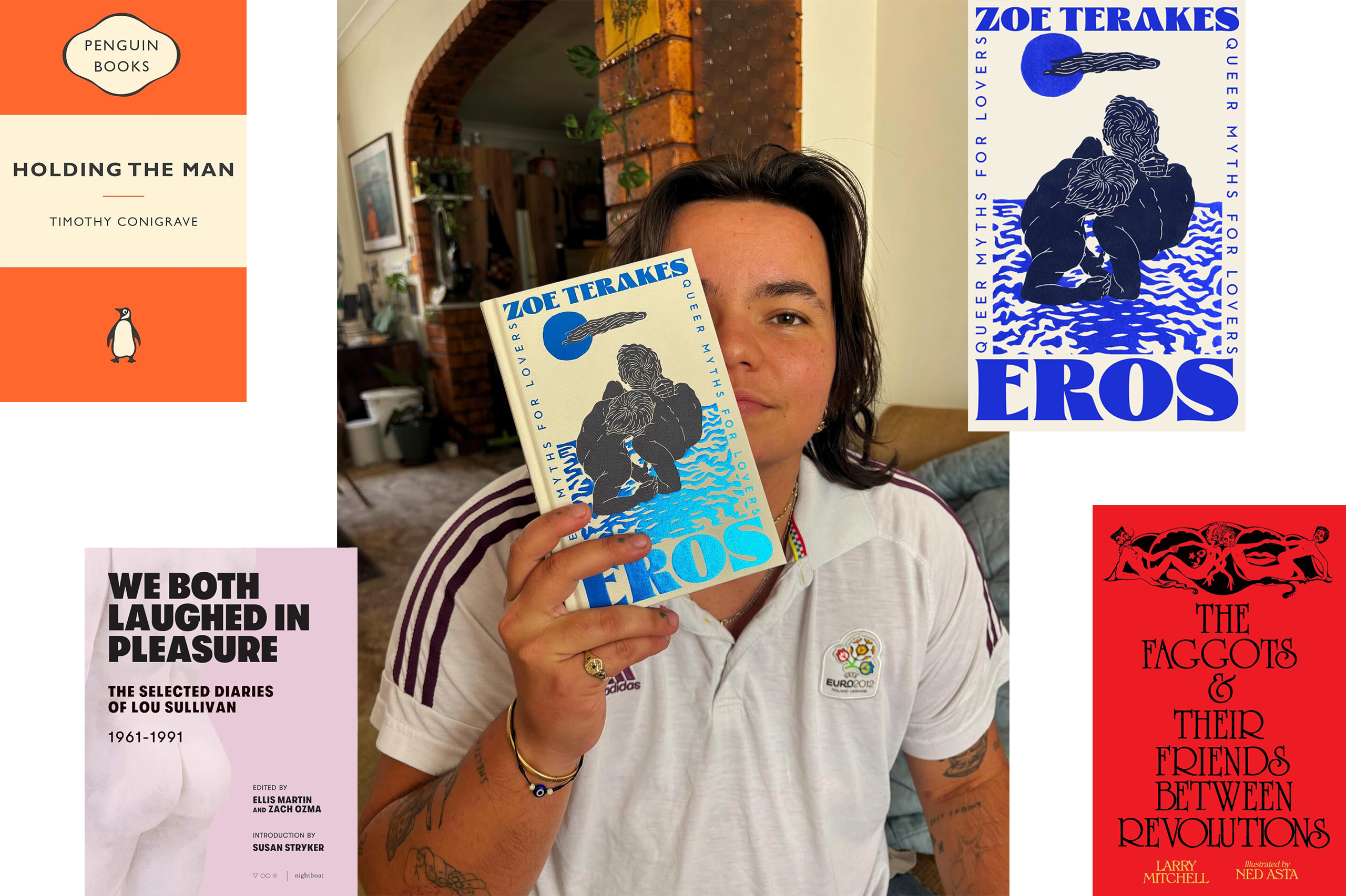
When Terakes spoke to RUSSH for our 20th-anniversary November issue last year, there was a quiet mention of what was coming next. Today, those plans are coming into fruition. Terakes debuts Eros: Queer Myths for Lovers, a bold, sensual reimagining of ancient Greek myths – stories carried through their Cretan heritage, and stories they always suspected contained more than the pared-back versions we were taught. In Terakes' hands, these myths break open as queer, tender, furious, and imaginative stories. Gods walk beside mortals, bodies shift form, desire becomes both compass and catalyst. The result is stories vividly alive, hot-blooded, poetic, and sharp.
Below, we speak with Zoe Terakes on their Cretan heritage that drew them to creating Eros: Queer Myths for Lovers, their favourite author, and a book everyone should read at least once.
Eros: Queer Myths for Lovers reimagines ancient myths through a queer, modern lens. What drew you to Greek mythology as a foundation for exploring queer identity and love?
Definitely my heritage. My family is from Crete, an island between Greece and North Africa, with Southern Italy on the left and Turkey on the right. I have been drawn to the mythology of my people since I was really little. Queerness and transness are entrenched in the bones of these myths. But because our mythology has largely been documented by cis, heterosexual men, the queer and trans stories have been folded down, smaller and smaller, until it is almost impossible to see them at all. I made it my duty to excavate these stories, our stories, with the queer and trans experience at the forefront.
Many of the stories blur boundaries between gods and mortals, gender and form. What does divinity mean to you?
Divinity, like myth, is something I don’t see as separate to us. I believe our Angels walk among us. I think all divinity, gods, monsters, are much closer to us than we think. I think there is actually much less space between myth and reality than we think, I believe that ancient myths play out around us all the time, for all time.
How did your experience as an actor influence your voice and rhythm on the page?
I actually found it quite helpful as a way to get inside the head of a character. Being an actor, to me, means focussing on the details of a person; where they sit in your body, where their voice comes from when they speak, etc. So being able to use that as a way in to the characters in my book was really helpful.
You’ve said Eros: Queer Myths for Lovers' is inspired by your Cretan heritage. How did connecting with your ancestry influence the book’s creation?
Well, I think it just made the space between myself and what I was writing about almost non-existent. For instance, the first story in the book tells the myth of Iphis, a young trans boy living in ancient Crete. Living inside a story that is so old, yet almost uncannily relatable, was pretty magic. I definitely feel closer to myself and to the old stories of my island as a result of it.
View this post on Instagram
What are you currently reading?
I just finished reading City of Night by John Rechy, a Mexican American author who was kicking around the gay hustling scene in the 60s. The book moves from New York City, to San Francisco, then to Chicago, then ends in New Orleans, Louisiana. It exposes the queer, hedonistic underbelly that pulsed through those cities. And I’ve just started reading In the Dream House by Carmen Maria Machado, which I’m loving so far.
What is your favourite book of all time?
Oh God, this is such a hard question to answer. Both Loaded and Merciless Gods by Christos Tsiolkas would be up there. And also, all of Camila Sosa Villada’s work. The Queens of Sarmiento Park and I’m a Fool to Want You are such living, breathing books. She is such a visceral writer. I just love her.
What literary character do you most identify with?
Oh! That’s a cool question. The first time I read Stone Butch Blues, I was in total disbelief at how relatable the protagonist’s experience was. I think so many transmasc folks have that experience reading Feinberg’s work. It is devastatingly relatable. Also, the ten-year-old narrator in Andrea Abreu’s Dogs of Summer. There is a hunger and a longing and a shame in her that I felt so deeply as a queer kid. It is an extraordinary book.
What is a book that changed your life?
Lou Sullivan’s Diaries, We Both Laughed in Pleasure, floored me. I read it almost cover to cover on a solo camping trip on Worimi Country. Lou kept diaries from when he was a kid, right up until the days before he died of AIDS. He was a gay trans man and his ability to remain in pursuit of joy, wonder and expansion, even in the face of death, is incredibly moving. Also, I know it’s a play, but Angels in America by Tony Kushner cracked my brain open and made me realise the kind of art I want to make.
Growing up, the best book on your bookshelf was?
Holding the Man by Timothy Conigrave. It was the first book I read that was set in Sydney, around the area I grew up in. It obviously wrecked me, but it also gave this promise of a queer community that, at the time, seemed totally out of reach.
Your favourite living author is?
Fuck, that’s really hard. I’d have to say Camila Sosa Villada. She is a trans, Argentine woman and as I said before, you can almost feel blood pumping through her work. It’s the closest I have ever come to being fully Jumanji’d. I was sucked in.
What is a book everyone should read at least once is?
The Faggots and Their Friends Between Revolutions by Larry Mitchell. It is written in parables, fables and little manifestos. Published in 1977, the book describes an empire in decline, then introduces us to the faggots, the women, the queens, the women who love women, and the fairies, who are all resisting and organising against the world order of men. It is one of those golden pieces of writing that we are so lucky to have access to. When the current pervasive fascism feels insurmountable, this book illuminates the way forward, like a little Angel with a trumpet, showing us the way home.