
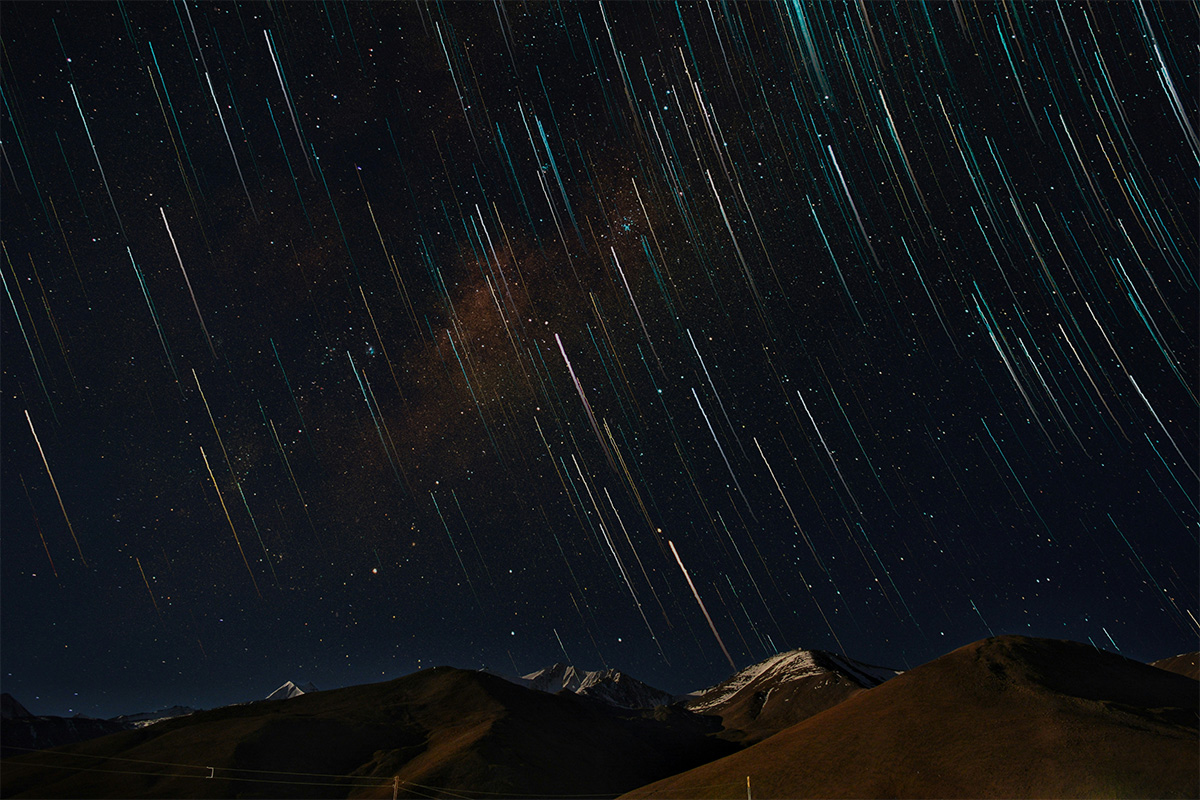
The holidays aren't here yet, but for the sky-obsessed amongst us, Christmas has come a little early. What's dubbed as the best meteor shower of the year — aka, the Geminids meteor shower — is back. Each December, it delivers brighter, longer and more frequent shooting stars than almost any other celestial event, and in 2025, stargazers in Australia are in for an especially clear show.
With minimal moonlight expected during the peak, this year’s display is forecast to be vivid across much of the country, thanks to extra dark skies. Here's when and where to see it from your location.
When is the Geminids meteor shower in Australia?
In Australia and New Zealand, the Geminid shower is expected to peak overnight on 14 December, and into the early morning of 15 December 2025.
You'll have to be a night owl if you want the most impressive view. The best viewing window is typically from midnight through to dawn, with the most intense activity happening around 2–3am AEDT. This is when the source point of the meteors is highest in the sky, giving you the best chance of spotting more shooting stars per hour.
These are the viewing windows across the night and early morning of 14-15th December adjusted for local time in your city:
- Sydney: 11pm - 6am
- Melbourne: 12am - 6am
- Brisbane: 9pm - 5am
- Perth: 10pm - 5am
- Canberra: 11pm - 6am
- Adelaide: 11.30pm - 5.30am
- Hobart: 12am - 5am
- Darwin: 9.30pm - 6.30am
If you miss the exact peak, all is not lost: the nights of 13 and 15 December are likely to also offer a strong display.
Where in the sky do I look to see the meteor shower?
You don’t need a telescope or special gear to see this. The Geminids appear to radiate from a single point in the sky called the radiant, which lies within the constellation Gemini. Think of it like the origin of the shooting stars — the meteors streak away from this point in all directions.
You also don’t need to stare directly at the radiant. In fact, the best view is usually about 45 degrees away from it, where the meteors are more likely to streak across the sky in a way that fills your vision.
A simple way to gauge this:
- Find Orion — it’s one of the easiest constellations to spot.
- Estimate roughly 45 degrees from Orion in whichever direction gives you a darker, open patch of sky.
- Lie back, let your eyes adjust to the dark for at least 20–30 minutes, and enjoy the show.
Can I see the Geminids from the city? Yes, but less light pollution is better
Yes, you can. That's what's so special about this particular meteor shower. Many of the Geminids are bright enough to be visible from suburban and even inner-city locations.
That said, you’ll always see more if you travel away from streetlights and buildings. You can try finding a dark sky reserve near your city for the best view. For example, if you live in Sydney, Palm Beach has been designated as an Urban Dark Sky Place. This would be the perfect location from which to watch the Geminids Meteor Shower.
What makes the Geminids different from other meteor showers?
While many other meteor showers are caused by icy comets, the Geminids come from debris left behind by a rocky body known as Phaethon. This produces bright, slow-burning meteors that often leave glowing trails behind them, making them easier to see with the naked eye.
The Geminids are also known for producing frequent bursts — meaning you can see several shooting stars close together rather than one every now and then.


Feature image by Rishabh Pandoh via Unsplash.
Want more sky goodness? Here's what you need to know about the latest Aurora Australis, and our guide to every solar eclipse visible from Australia.