
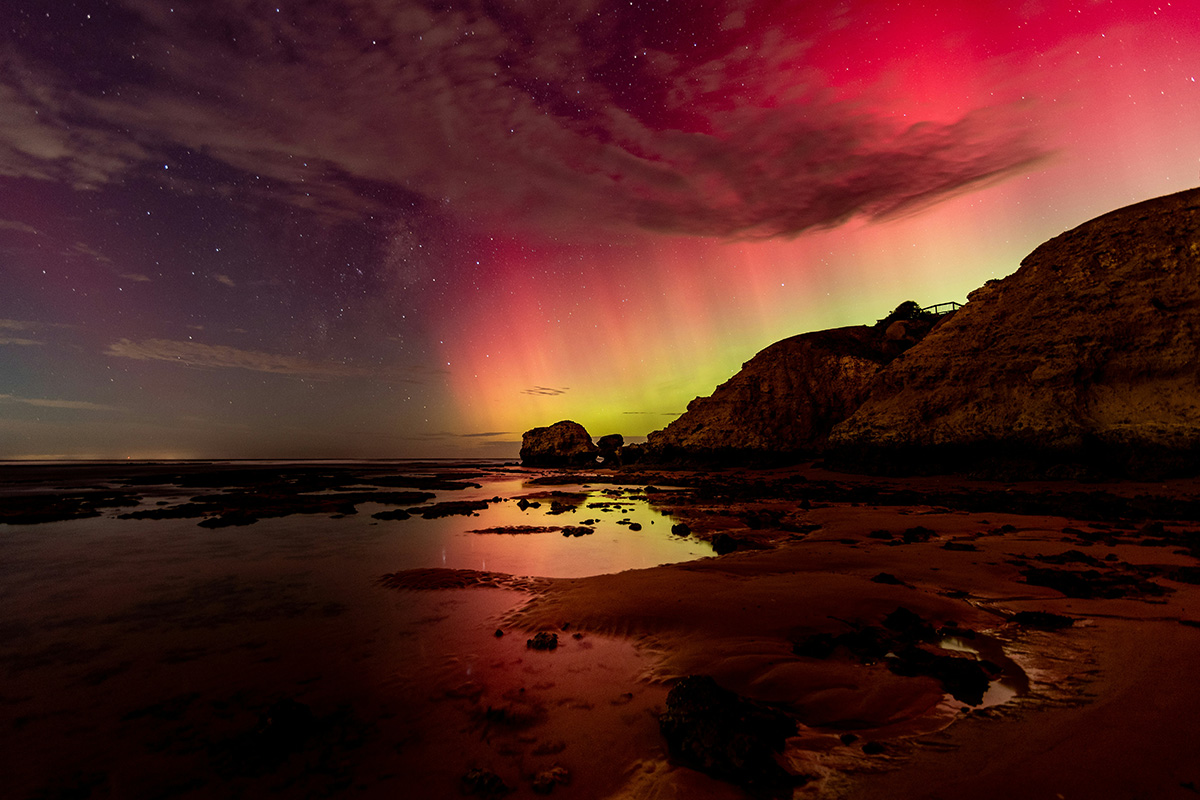
Last night, a large portion of Australia was treated to a spectacular view, when the skies were illuminated in shades of blue and green thanks to the Aurora Australis.
If you missed it, you're in luck. The Bureau of Meteorology has confirmed there’s a strong chance the lights will return tonight, thanks to what scientists are calling a severe geomagnetic storm — the kind that makes the atmosphere itself shimmer. Here's what to know about how to catch the Southern Lights.
Where and when to see the Aurora Australis tonight
As always, the further south, the better. Tasmania, southern Victoria, and South Australia are your best chances — though if tonight's storm is as strong as expected, it could reach parts of New South Wales and Queensland.
The Aurora Australis tends to appear after dark and may linger through the early hours. The fewer streetlights, the better — head for open fields and beaches for the best viewpoint.
What time can I see it?
According to the Bureau of Meteorology, the Aurora Australis is most visible during local night-time hours, particularly across southern regions of Australia.
Photographs from last night suggest the lights began to appear not long after sunset in some areas, and intensified as darkness deepened. If conditions hold, the hours between dusk and midnight are likely to offer the most dramatic views.
What actually is the Aurora Australis?
The Aurora Australis is the southern hemisphere’s counterpart to the Aurora Borealis — the Northern Lights. It occurs when streams of charged particles from the Sun, known as the solar wind, interact with Earth’s magnetic field. These particles are guided toward the polar regions, where they collide with gases in the upper atmosphere, producing light in vivid shades of green, pink, and violet.
Typically, the phenomenon is confined to regions close to Antarctica. However, during periods of intense solar activity — particularly when large eruptions of plasma called coronal mass ejections reach Earth — the aurora can extend much further north. That’s what happened last night (and will hopefully repeat tonight), when a powerful geomagnetic storm created a rare and spectacular display across southern Australia.


Feature image by Graham Holtshausen, via Unsplash.